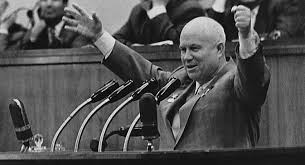
If you were a politician during the reign of Stalin, Nikita Sergeyevich Khrushchev would be no stranger to you. Khrushchev was a heavy advocate for agricultural reform during Stalin’s reign. It was well known that Khrushchev did not agree with the way Stalin was handling the economy. Khrushchev thought that too much money was being spent on the military and the industrial sectors of the economy and that the Russian Federation would eventually regret not investing more in agriculture (Vilon). To emphasize how passionate Khrushchev was about agriculture, at one point during Stalin’s reign, Khrushchev was a Ukrainian party secretary. During his time in office, he received an unrealistic request for grain from Stalin that would put too much stress on Ukraine’s grain production. Khrushchev denied Stalin his request, and in turn did not buy himself any favors in the political spectrum. Nonetheless, Khrushchev once again found favor in the eyes of the people after Stalin’s death (Freeze).
All this being said, it was no surprise that Khrushchev built his campaign for First Secretary of the Central Committee off of his plans for economic reform. Khrushchev’s attempt at agricultural reform was not gradual or risk free. His plan was to “increase agricultural production sharply and as rapidly as possible” (Vilon) This meant that Khrushchev took big risks in order to boost agricultural production. One of these risks was the Virgin Lands Campaign. The objective of The Virgin Land campaign was to immediately increase the amount of farmland in the Russian Federation and in turn create a larger infrastructure built off of grain production. With the majority of the Federation’s grain coming from these virgin lands, Ukraine would be able to focus on corn production. Ukraine being able to produce more corn would be very important later on (Siegelbaum). This campaign was met with heavy resistance in the Central Committee. Many members were still leaning towards boosting and relying on heavy and light industrialization. Many people thought that the agricultural infrastructure was fine and that industrialization would in turn help the agricultural aspect of the economy in time.
After much discussion and back and forth, Khrushchev eventually wore down the committee and in 1954, the Central Committee signed off on the Virgin Land operations. 19 million hectares (the equivalent of about 47 million acres) was immediately plowed. Most of the land that was plowed was in northern Kazakhstan and the Altai region. Over 300,000 workers were brought in to cultivate the land and many more were shipped in every new season (Siegelbaum). These workers came from multiple different republics of the Russian Federation. Initially, the Virgin Land operation did not seem successful. The harvest in 1955 left much to be desired, but this did not discourage or slow down Khrushchev. That year, 14 more hectares were plowed, and once again, swarms of workers were brought in from all over to work the crops. Khrushchev got a taste of success in 1956, with the largest amount of grain produced the Russians had ever seen. More than 125 million tons of grain was produced, and more than half of this came from Khrushchev’s virgin lands (Siegelbaum).

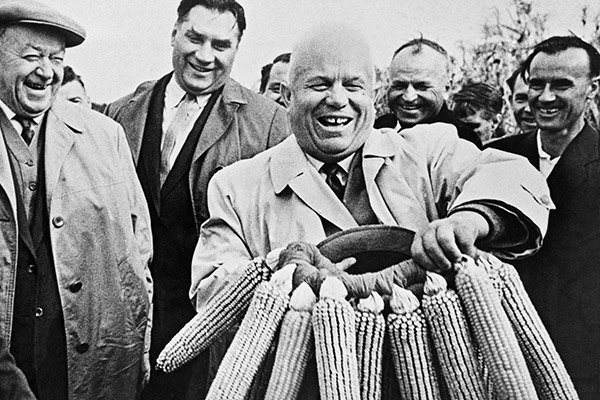
Khrushchev was not only concerned with the shortage of grain production in Russia, but he was also concerned with the lack of livestock. He said, “There will be no communism if our country has as much metal and cement as you like but meat and grain are in short supply.” This being said, Khrushchev set out to solve the livestock problem. Khrushchev realized that for there to be livestock, there has to be feeder, and corn was the most effective feeder at the time. Going back to what I said earlier, the Virgin Land campaign allowed Ukraine to focus on corn production. Khrushchev used every resource he had available to fix this “corn shortage.” Seed corn was imported from the United States, a corn research institute was opened in Ukraine, and Ukraine more than tripled its acreage used to plant corn. Khrushchev’s sudden efforts to increase corn production seemed to pay off (Gelden). The resources he used combined with good weather during the first few years created a surplus of corn in the Russian Federation. Khrushchev began to be referred to as “Kukuruzshchik” or “kukuruznik” which means “Mr. Corn” or “the maize enthusiast” (Pike). It seemed as of Khrushchev had pulled off the impossible. Within three years, grain and corn production was at an all time high and livestock began to prosper because of it.
Although everything seemed to be going good for Khrushchev, the “high-risk” portion of his plans ended up coming back around to bite him. It would seem that relying solely on the sheer amount of acreage dedicated to corn and grain would end up costing Khrushchev much more than he anticipated. Unfavorable weather including droughts in 1956, harsh freezes in 1959, and random weather changes in the early 60’s would lead to a deterioration of Khrushchev’s reputation. Lack of investment in good fertilizer, proper harvesting machinery, and a shortage of storage all led towards a very disappointing harvest in 1963 (Pike). Khrushchev was already losing political support over some of his policies and civil unrest, his economic success seemed to be the only thing keeping him afloat. This being said, the harvest of 1963 did not meet the needs of the Russian Federation and thus Khrushchev’s time as the Head of the Central Committee came to an end (Freeze). To end on a more positive note however, Khrushchev’s crops saw a major boost the next year in 1964 and it ended up being the largest harvest since the birth of his Virgin Land operation. Khrushchev’s agricultural feats were celebrated for decades to come (Pike). (See a stamp of the 25th anniversary of the Virgin Land Campaign below.)

Citations
Freeze, G. L. (2009). Russia: a history. Oxford: Oxford University Press.Geldern,
Geldern, J. von. (2017, June 18). Corn Campaign. Retrieved from http://soviethistory.msu.edu/1961-2/corn-campaign/
Pike, J. (n.d.). Military. Retrieved from https://www.globalsecurity.org/military/world/russia/cccp-ag-khrushchev.htm
Siegelbaum, L. (2015, September 1). Virgin Lands Campaign. Retrieved from http://soviethistory.msu.edu/1954-2/virgin-lands-campaign/
Volin, L. (1959). Soviet Agriculture under Khrushchev. The American Economic Review, 49(2), 15-32. Retrieved April 19, 2020, from http://www.jstor.org/stable/1816099
Watkins, T. (n.d.). The Virgin Lands Program in the Soviet Union under Nikita Khrushchev. Retrieved from https://www.sjsu.edu/faculty/watkins/virginlands.htm
 Jake's Blog
Jake I really enjoyed this posted, you offered a lot of insight on the agricultural plan Khrushchev laid out and pursued. My post was similar to yours as well. What I found so interesting as reading your blog post and doing research for mine was that this agricultural program was a huge success for several years and I don’t think many expected that. On top of that Khrushchev was convinced that he could overtake the U.S. in agricultural production and fell in love with corn because of the U.S. I don’t think it would have been a surprise if Russia overtook the U.S. in that category because they increased production rapidly. Unfortunately, mother nature wasn’t on their side for a couple of years and wind erosion destroyed almost half of the cultivated land. With a little more care to the land each year I think they easily could’ve overtaken the U.S. in agricultural production.
LikeLiked by 1 person
I’m so glad you found Jake’s post, Josh! I was just getting ready to flag it for you. Your two posts complement each other really well.
LikeLike
I am sure that surpassing the U.S. would have done wonders for Khrushchev and his plans for Russia. It would have been difficult to keep up with the U.S. due to the U.S. having a much more developed agricultural infrastructure that had been in place for longer than Russia’s. It goes to show that it takes more than pure mass and land to create a steady and long lasting agricultural sector.
LikeLike
Lovely post! I was wondering if Khrushchev knew, when conducting his Virgin Land campaign, that weather, while essential, is unpredictable. If so, was this just one big gamble for him?
LikeLike
Khrushchev knew that weather was a factor. He was no stranger to agriculture and made sure that he was well informed. He knew that there was a large risk, but that is how strongly he felt about the matter. He thought that the economy was doomed anyway and that the agriculture problem was only going to get worse. This being said, he thought the reward would be worth the risk.
LikeLike
Great post! You really shows how much emphasis Khrushchev placed on the development of agriculture. It is a definite contrast to the focus on industry during Stalin’s time and highlights some of the major differences between the two leaders. I find it interesting how successful many of his agriculture programs ended up being after his fall from power, and that a lot of them seemed to have been kept in place despite Khrushchev no longer being there.
LikeLike
Totally! Russia really reaped the benefits of what Khrushchev sowed for decades(pun intended). The economy that he built helped pave the way towards some type of stability and improvement.
LikeLike
Jake, it is very interesting how much emphasis Khrushchev placed on agricultural production despite rival opinions. He seemed to recognize the importance of healthy agricultural production in order to support increasing industrialization in the rest of the USSR. Despite the high risk nature of his plans, his policies, which were less repressive than those of Stalin’s regime, ultimately advanced the agricultural base of the USSR. Great post!
LikeLike
I appreciate your reply. Khrushchev definitely foresaw the issue of having to import food and other necessities in order to fuel the industrial side of the economy. I do not think that Khrushchev disliked the industrial sector and I think he definitely understood its importance in the economy. However, he realized that it would all mean nothing if the workers were not being fed, the people were unhappy, and Russia had to continuously rely on other countries to make up for the lack of a diverse economy.
LikeLike
Hey Jake, I enjoyed reading your post! I had no idea just how much Khrushchev loved corn, and his heavy focus on agricultural infrastructure improvements did seem to pay off overall. I also found it interesting that Khrushchev had the guts to deny Stalin’s request outright, and he still went on to land the political position that he did.
LikeLike
Honestly I couldn’t imagine standing up to Stalin during his reign. I would like to do more research into that exchange to see exactly what happened and why. It seemed to work out for Khrushchev in the end however. I would assume that not many political actors under Stalin got away with things like that.
LikeLike
Jake, I liked your blog when you pointed out the practical realization of Khrushchev that the people didn’t need the metal and concrete for work if there was no meat or grain to eat. Khrushchev did focus on the needs of the people, too bad he did not remain in power.
LikeLike
Hey Tom, I appreciate your response. It is true that Khrushchev did try to be a man of the people. He wanted the people fed well and invoked multiple policies that gave more power and freedom to the people especially concerning their jobs and economic freedoms.
LikeLike
Thanks for this very informative analysis of how crucial the Virgin Lands were to Khrushchev’s agricultural policy, and how closely the program was linked to his political fortunes as well. You’ve got some great questions here, so I’ll just note that I really appreciate how you highlight the connection between increasing meat consumption with improved industrial performance. — both suggest that the consumer economy would be king in the postwar era.
LikeLike
I really think it goes back to the whole concept of how different sectors of a countries economy overlap at certain points. Russia had a very one-dimensional economy. When the agriculture sector took off, it boosted the other parts of the economy, even the industrial sector.
LikeLiked by 1 person
Thanks for the informative post! As I was reading Freeze, I kept wondering why Khrushchev kept emphasizing maize over wheat or other grains. Your explanation of its importance in supporting a large meat industry filled in that gap.
LikeLike
Jake, I really enjoyed reading your post. I loved how you brought a focus to Khrushchev’s concern over livestock shortages and his desire to spend more time focusing on agriculture and not so much on military and industry. I also appreciated how you included Khrushchev’s denial of Stalin’s request; it was a ballsy move to make, especially when you have nothing to gain from it.
LikeLike
Wow, it sounds like Krushchev’s agricultural program had promise. It is crazy to think how much weather may have altered the course of human history. I wonder what could have been had wind not eroded so much of the Soviet agricultural land.
LikeLike
This was a very great post, that I enjoyed. Krushev was born in a largely agrarian and agricultural area, he was born near the Ukrainian border, the Ukrainian lands being the “breadbasket of the Soviet Union.” I wonder if the area and lifestyle he was born into, affected his policy decisions and his willingness to pursue this agricultural program that he did?
LikeLike
Great post, Jake! I found it weird that the Soviet Union had imported seed corn from their even then rivals, the United States. I guess you really can’t go at it alone, especially within the last 100 years with the rise of globalization.
LikeLike
Great post! Isn’t it funny how even the most powerful nations are still limited by something as simple as wheat and corn. Whats even funnier to me is how they asked the US, their principle rival, to help them grow it. Its kind of nice to see that even in the midst of a global ideological struggle we can still come together over food
LikeLike